

Do you want a European degree without learning a new language first? Then the Netherlands should be on your list. Every year, thousands of students study in Netherlands in English, and the country offers one of the biggest English-taught choices in continental Europe.
This guide walks you through the full process. You will learn which programs exist, what they cost in 2026–27, how to apply, which visa rules apply, and where to find scholarships. We checked the latest official and university figures, so you can plan with real numbers.
Here is the short version. Master’s students have the widest choice, because about 76% of master’s programs in the Netherlands are still taught in English. Bachelor’s options are fewer than before, but they still exist. EU students pay about €2,694 per year, while non-EU students usually pay between €10,000 and €30,000 or more.

Let’s start with the basics.
What Does It Mean to Study in Netherlands in English?
When you study in Netherlands in English, you take a full degree where lectures, exams, and your thesis are all in English. You do not need to speak Dutch to be admitted. Your classmates come from many countries, and daily life in Dutch cities is easy in English too.
The scale is big. According to Nuffic, Dutch institutions enrolled 129,764 international students in 2025/26. That was also the first-ever decrease in foreign enrolment, so universities are not as crowded as the headlines suggest.
Common misconception: many people think English-taught degrees are being banned. That is not true. In July 2025, the Dutch government set aside measures that would have restricted English-taught degrees, as ICEF Monitor reports. Still, universities cut English-taught bachelor’s programs by about a third over the past couple of years. Bachelor’s applicants should check each program page carefully.
Key Takeaway: Master’s students have the most English-taught options. Bachelor’s applicants have a smaller list, so research early.
Types of English-Taught Programs in the Netherlands
Research Universities (WO)
These programs focus on theory and research. They suit you if you want an academic path, a master’s, or a PhD later. Examples include Leiden University, Utrecht University, and Maastricht University.
Universities of Applied Sciences (HBO)
These programs are practical, with internships and strong links to industry. Examples include NHL Stenden, Inholland, and HAN. Non-EU fees at applied sciences universities are often lower than at research universities.
Bachelor’s vs. Master’s Programs
Bachelor’s degrees usually take three years at research universities and four years at applied sciences universities. Master’s degrees usually take one to two years. Most international students choose a master’s.
Pro Tip: Start your search on the government-backed Study in NL portal and filter by English and your degree level. It is a safer starting point than agent websites.
How to Apply to Study in Netherlands in English
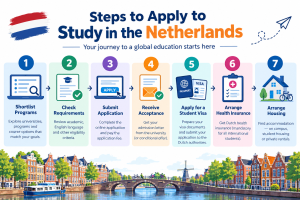
- Shortlist 2–4 programs. Check the language of instruction on the program page, not only in the title.
- Read the admission rules. Check your diploma level, grades, English score, and extra documents such as a motivation letter.
- Check the deadline. Deadlines differ by university and program. Programs with limited places often close early.
- Apply. You register in Studielink, the central Dutch enrolment system, and often also use the university’s own portal. Upload your documents.
- Accept your offer and pay. Follow the steps in your admission letter.
- Get your residence permit (non-EU students). In many cases the university applies to the IND for you. You pay the IND fee and show proof of funds.
- Arrange housing and health insurance. Do this early.
Important: Student housing is very tight in Dutch cities. Start your housing search the day you apply, not after you receive your offer.
Requirements and Eligibility
Every program sets its own rules, but most ask for the following:
- Previous diploma: a secondary school diploma for bachelor’s programs, or a relevant bachelor’s degree for master’s programs.
- English skills: an IELTS score of about 6.0–6.5 or a TOEFL equivalent is common. Some programs want more.
- Documents: passport, transcripts, CV, and a motivation letter. Master’s programs may also ask for references.
- Proof of money (non-EU): for 2026, the IND study amount is €1,130.77 per month, or €13,569.24 for 12 months. Tuition is extra.
- Permit fee (non-EU): the IND fee is €254 in 2026.
- Health and other checks: Dutch health insurance rules apply, and students from some countries need a TB test.
EU/EEA citizens do not need a student residence permit. Check the official IND required amounts page before you transfer any money, because the numbers change every year.
Costs and Benefits of Studying in the Netherlands
The fee you pay depends on your nationality. EU/EEA, Swiss, and Surinamese students pay the government-set statutory fee. Everyone else pays an institutional fee that each university sets.
| Who Pays | Program | 2026–27 Tuition |
|---|---|---|
| EU/EEA, Swiss, Surinamese | All programs (statutory fee) | €2,694 |
| Non-EU | NHL Stenden, bachelor’s or master’s | €10,335 |
| Non-EU | Design Academy Eindhoven, bachelor’s | €12,449 |
| Non-EU | Leiden University, International Studies BA | €14,300 |
| Non-EU | Design Academy Eindhoven, master’s | €19,762 |
| Non-EU | Leiden University, School Psychology MSc | €22,300 |
Fees vary a lot. Maastricht University, for example, lists non-EU fees from €13,200 to €32,000, depending on the program level. Living costs are extra. Study in NL says students spend about €1,000–€1,500 per month, and big cities like Amsterdam cost more.
Pro Tip: If you plan to start in September 2027, expect slightly different fees. The statutory fee rose from €2,601 to €2,694 for 2026–27. Always check the program page for the exact year.
Working While You Study
Non-EU students can work up to 16 hours per week, or full time in June, July, and August, but not both. Your employer must get a work permit (TWV) first. EU/EEA students can work without these limits. A part-time job helps with daily costs, but it will not pay your tuition.
Important: Starting work before the permit is in place can mean a fine for the employer and the loss of your residence permit.
Why Students Choose the Netherlands
- Many English-taught programs, especially at master’s level
- An international classroom with students from around the world
- A 12-month orientation year (zoekjaar) after you graduate, where you can look for work or start a business without a sponsor
- A central location for travel across Europe
Tips for Success
- Start 9–12 months early. Documents, visas, and housing all take time.
- Apply to 2–3 programs. Some programs have limited places.
- Make your motivation letter specific. Explain why you want this program, not only why you want the Netherlands.
- Plan the full budget. Add tuition, rent, insurance, the IND fee, and a buffer of at least a few hundred euros.
- Learn basic Dutch. You can live in English, but simple Dutch helps in shops and part-time jobs.
Common mistakes to avoid: trusting agents instead of official university pages, using the wrong fee category for your nationality, and missing deadlines.
Scholarships and Useful Resources
NL Scholarship (Formerly Holland Scholarship)
This is the national scholarship for non-EEA students. It gives €5,000 once, in your first year only. It is not a full-tuition scholarship. Each participating university sets its own deadline, and for 2026–27 most fell between February and May. Applications for 2027–28 are expected to open around 1 November 2026, so check the Study in NL site now.
University Scholarships
Many universities have their own awards. For example, Leiden University offers the Leiden University Excellence Scholarship (LExS) for non-EU/EEA master’s students. Check the “fees and scholarships” page of each program.
Official Resources
- Study in NL: programs, scholarships, and student life
- IND: residence permit rules, fees, and required amounts
- Studielink: the central Dutch enrolment system
- Nuffic: diploma recognition and country information
FAQs
Can I study in the Netherlands in English without knowing Dutch?
Yes. In English-taught programs, classes, exams, and your thesis are all in English. You only need to prove your English level, usually with IELTS or TOEFL. Basic Dutch is optional, but it makes daily life easier.
How much does it cost to study in the Netherlands in English?
EU/EEA students pay €2,694 per year for 2026–27. Non-EU students pay institutional fees, which range from about €10,000 to over €30,000 depending on the program. Add roughly €1,000–€1,500 per month for living costs.
Which English test do I need?
Most programs accept IELTS Academic or TOEFL iBT. A score around IELTS 6.0–6.5 is common, but each program sets its own minimum. Check the admission page of your program.
Can I work while studying in the Netherlands?
EU/EEA students can work without limits. Non-EU students can work 16 hours per week, or full time in June, July, and August, with a work permit arranged by the employer.
Can I stay in the Netherlands after I graduate?
Yes. Non-EU graduates of Dutch programs can apply for the orientation year permit. It lasts up to 12 months, allows any paid work, and cannot be extended.
Do I need a visa to study in the Netherlands?
EU/EEA students do not. Most non-EU students need a residence permit. Your university usually applies to the IND for you, and the IND fee is €254 in 2026.
How much money do I need to show for a Dutch student visa?
The IND study amount for 2026 is €1,130.77 per month, which is €13,569.24 for 12 months. This covers living costs only. Tuition is separate.
Final Words
If you want to study in Netherlands in English, the path is clear when you take it step by step. The country offers many English-taught programs, a strong international classroom, and real chances to work and stay after graduation.
Key points to remember:
- Master’s programs have the widest English-taught choice, with about 76% taught in English.
- Bachelor’s options are fewer, so check each program page.
- EU students pay €2,694 for 2026–27. Non-EU fees usually run from about €10,000 to over €30,000.
- Non-EU students must show €1,130.77 per month and pay the €254 IND fee.
- The NL Scholarship offers €5,000, and the next round is expected to open around 1 November 2026.
Your next step is simple. Open Study in NL today, pick two or three programs, and write down their deadlines. Then start your documents and housing search early.
Which program are you thinking about? Tell us in the comments, and we will help you plan your next step.